Want to remember why you love teaching? Read Catherine Denial’s A Pedagogy of Kindness
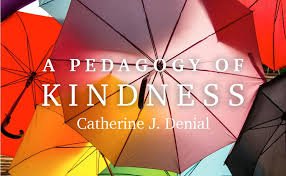
Today, I dove into Catherine Denial’s new book, A Pedagogy of Kindness, and by the time I reached the end of the first page, I was already making notes. Denial’s words struck a chord deep within me – finally, someone has articulated the hope I also have to create higher ed environments less immersed in politics, “individualism, competition, prestige, and distrust” (Denial, 2024, p. i).
Denial (2024) calls for a different kind of higher education environment, the kind of higher education environment I’m on a quest to nurture and lead through the Happier in Higher Ed community.
Imagine a community where we uplift each other, grapple with tough questions, and inspire deeper thinking. Imagine building a vibrant community of scholars, where students and educators alike flourish. Where we support each other, ask tough questions, challenge each other to think more deeply, and create authentic learning experiences and spaces where students can thrive. Where we trust each other, listen to each other, and support each other, even as we push boundaries as scholars and thinkers, grow together, and thrive.
The problems of the world are too vast and troubling for us to remain mired in competition and politics.
Denial (2024) reminds us that kindness involves truth and bravery, just as much as it involves compassion. “Here’s what a pedagogy of kindness most definitely is: It’s about attending to justice, believing people, and believing in people” (Denial, 2024, p. 2).
Too often, we think that kindness is the opposite of rigor. Or challenge. Or deep learning. We worry that demonstrating kindness means people will walk all over us. Or won’t listen to us. Or won’t learn what they need to learn.
But, as Denial (2024) writes, “Here’s what a pedagogy of kindness is not: It’s not about sacrificing ourselves and our well-being. It’s not about taking on more emotional labor (at least, not unless you are someone who is rarely called on to do any emotional labor at all). It’s not about complicating teaching even further. It’s about reorienting ourselves to a new way of thinking so that it strips away much of the burdensome work we’ve been imposing on ourselves for so long” (p. 2).
I can’t wait to read the rest of this book -- it’s truly inspiring!
Want to join me?